

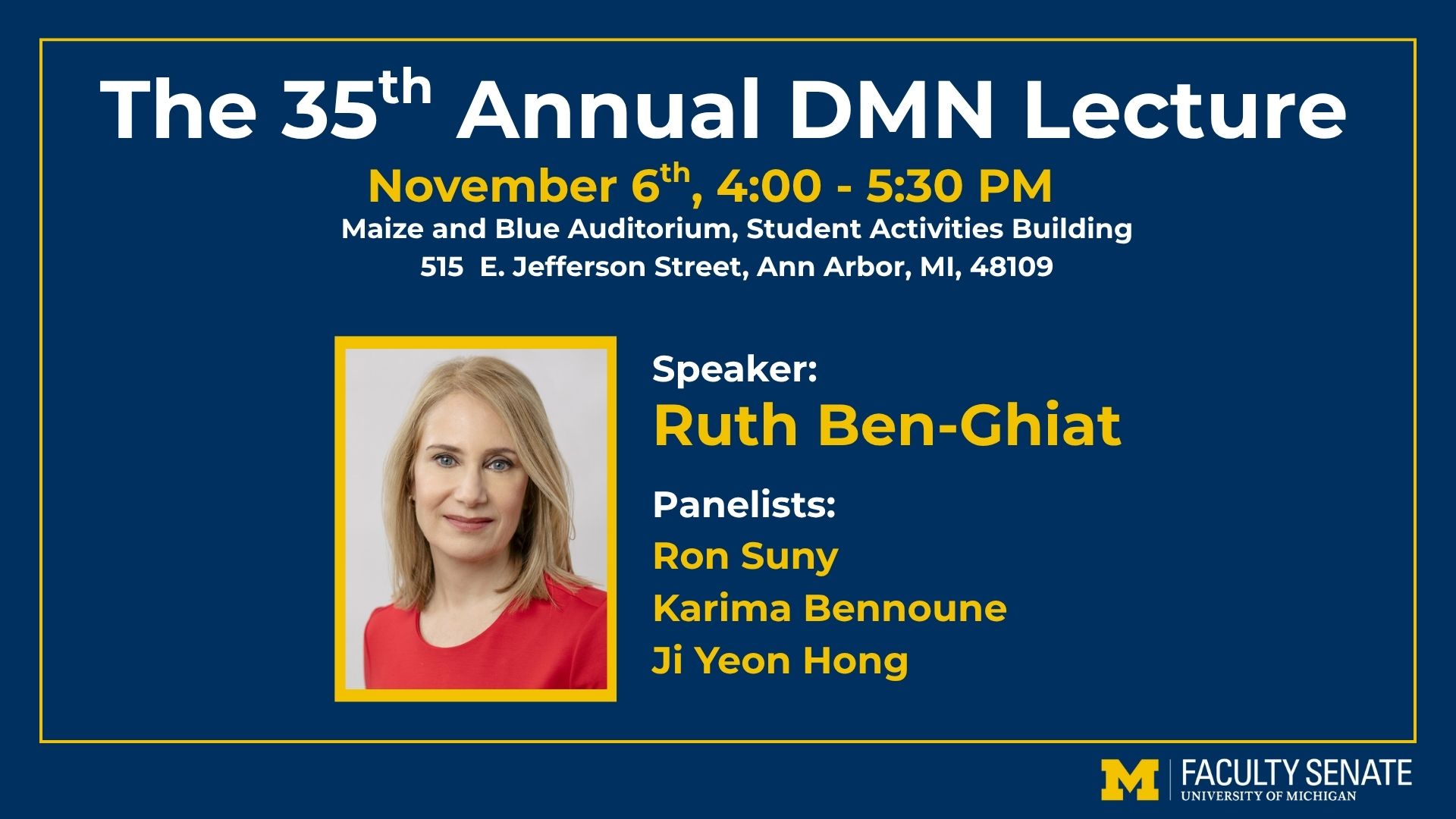
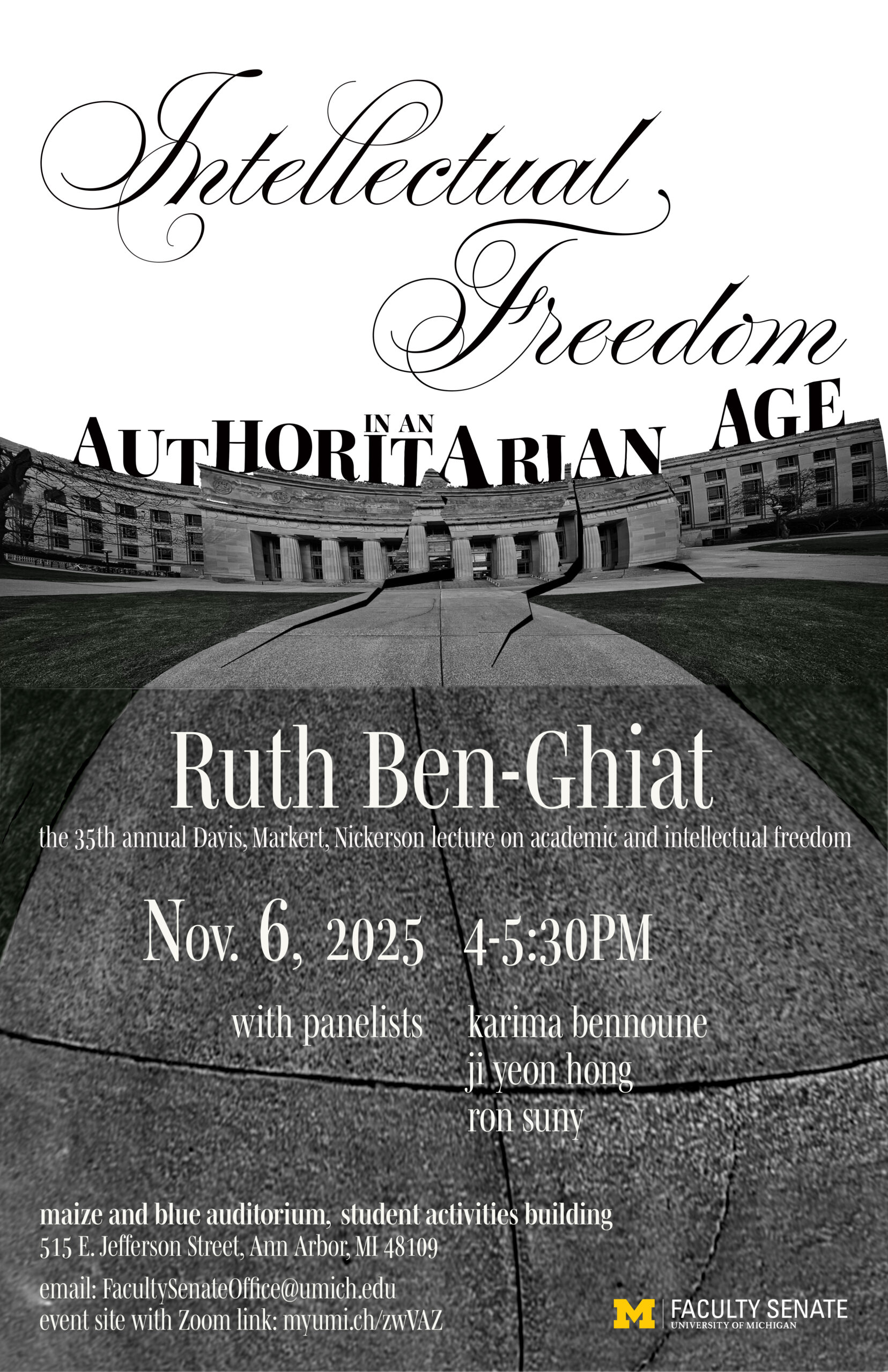
35th Annual Davis, Markert, Nickerson Lecture on Academic and Intellectual Freedom
“Intellectual Freedom in an Authoritarian Age”
The annual Davis, Markert, Nickerson Lecture on Academic and Intellectual Freedom is named for three U-M faculty members—Chandler Davis, Clement Markert, and Mark Nickerson—who in 1954 were called to testify before the House Un-American Activities Committee. All invoked constitutional rights and refused to answer questions about their political associations. The three were suspended from the University with subsequent hearings and committee actions resulting in the reinstatement of Markert, an assistant professor who eventually gained tenure, and the dismissal of Davis, an instructor, and Nickerson, a tenured associate professor.
Abstract:
“Intellectual Freedom in an Authoritarian Age”
This talk examines how authoritarians seek to silence intellectuals and all those who work with fact-based research protocols and democratic models of pedagogy. Researchers, journalists, academics, and scientists become threats when political leaders seek to manufacture an alternate reality that helps them to consolidate power and remain in office indefinitely. Such leaders transform educational and other institutions into sites that encourage authoritarian values and behaviors, circulate lies and conspiracy theories, and silence areas of knowledge and practice that conflict with their ideological goals.
I will also look at how educational institutions have contributed to resistance to authoritarian states, and the role educators can play in reversing the collective syndrome of moral collapse that such states depend on.
The talk is based on my research, interviews with people who have been silenced by dictatorships, and my own experiences, such as being banned from delivering the 2024 Bancroft Lecture at the United States Naval Academy after a campaign by the Heritage Foundation and GOP members of Congress.
Note: For reasons that she will explain at the lecture, Dr. Ben-Ghiat feels obliged to give her keynote talk remotely, via Zoom. Her lecture will be followed by a panel—live and in person—moderated by SACUA chair Derek Peterson.
Speakers
Derek Peterson, Faculty Senate Chair, Ali Mazrui Collegiate Professor of History and African Studies, Associate Chair, Department of History, Professor of History and Professor of Afroamerican and African Studies, College of Literature, Science, and the Arts.
Provost Laurie McCauley, William K and Mary Anne Najjar Professor of Periodontics, Provost and Executive Vice President for Academic Affairs, Office of the Provost and Executive Vice President for Academic Affairs, Professor of Dentistry, Department of Periodontics and Oral Medicine, School of Dentistry and Professor of Pathology, Medical School
Karima Bennoune, Lewis M Simes Professor of Law and Professor of Law, Law School
Jean Hong, Korea Foundation Professor of Korean Studies, Associate Professor of Political Science and Associate Professor in the International Institute, College of Literature, Science, and the Arts
Ronald Grigor Suny, William H Sewell, Jr Distinguished University Professor Emeritus of History, Professor Emeritus of History and Professor Emeritus of Political Science, College of Literature, Science, and the Arts
Program
3:30: Doors Open
Light refreshments will be provided:
Cookies, macaroons, cannoli, cheesecake, vegan/gluten free cupcakes, coffee, tea, and sparkling water
****
Main Program
4:00: Introductory Remarks
Derek Peterson, Faculty Senate Chair
Laurie McCauley, Provost and Executive Vice President for Academic Affairs
4:15: Lecture
Ruth Ben-Ghiat, Professor of History and Italian, NYU (appearing virtually)
4:45: Panel
Ruth Ben-Ghiat, Professor of History and Italian, NYU
Karima Bennoune, Lewis M. Simes Professor of Law
Jean Hong, Korea Foundation Professor of Korean Studies
Ronald Grigor Suny, William H Sewell, Jr Distinguished University Professor Emeritus of History
Moderator: Derek Peterson, Faculty Senate Chair
Book Launch
5:30: In the Spirit of H. Chandler Davis
Short segment (~10-20 minutes) in recognition of one of the three faculty
for whom the DMN lecture is named and announcing a new edited volume.
Gary D. Krenz, Director, retired, Judy and Stanley Frankel Detroit Observatory
Remarks in memoriam of Chandler Davis
Introduction of In the Spirit of H. Chandler Davis: Activism and the Struggle for Academic Freedom,
a new volume edited by Michael Atzmon, John Cheney-Lippold, Gary D. Krenz, and Melanie S. Tanielian
Sponsorship
The annual DMN Lecture series is supported by an endowed fund made possible through the generous contribution of an anonymous benefactor.
This year’s DMN lecture is also the recipient of a democracy grant from The Democracy & Civic Empowerment Initiative, which provides funding to uplift interdisciplinary democracy projects from across all three U-M campuses.
DMN Lecture Speaker Biography
Ruth Ben-Ghiat
Ruth Ben-Ghiat is Professor of History and Italian Studies at New York University. She writes about fascism, authoritarianism, propaganda, and democracy protection. She is the recipient of Guggenheim and other fellowships, an advisor to Protect Democracy, and an MSNBC opinion columnist. She appears frequently on CNN, MSNBC, PBS, and other networks.
Her latest book, a New York Times bestseller, Strongmen: Mussolini to the Present (2020; paperback with a new epilogue, 2021), examines how illiberal leaders use corruption, violence, propaganda, and machismo to stay in power, and how resistance to them has unfolded over a century.
She is also a consultant for businesses, civil society organizations, and television and film productions, including Guillermo del Toro’s Academy Award-winning 2022 movie Pinocchio and the 2024 Netflix docuseries Hitler and the Nazis: Evil on Trial.
Panelist Biographies
Karima Bennoune
Karima Bennoune, ’94, is the Lewis M. Simes Professor of Law at the University of Michigan. She specializes in public international law and international human rights law, including issues related to culture, extremism and terrorism, and women’s human rights.
Ji Yeon Hong
Ji Yeon (Jean) Hong is an Associate Professor of Political Science and Korea Foundation Professor of Korean Studies. Her research focuses on the political economy of authoritarianism, with particular attention to East Asia.
Ronald Suny
Ronald Grigor Suny is the William H. Sewell Jr. Distinguished University Professor of History and Professor of Political Science at the University of Michigan and Emeritus Professor of Political Science and History at the University of Chicago. Professor Suny’s intellectual interests have centered on the non-Russian nationalities of the Russian Empire and the Soviet Union, particularly those of the South Caucasus (Armenia, Azerbaijan, and Georgia).
Related Events:
BOOK READING
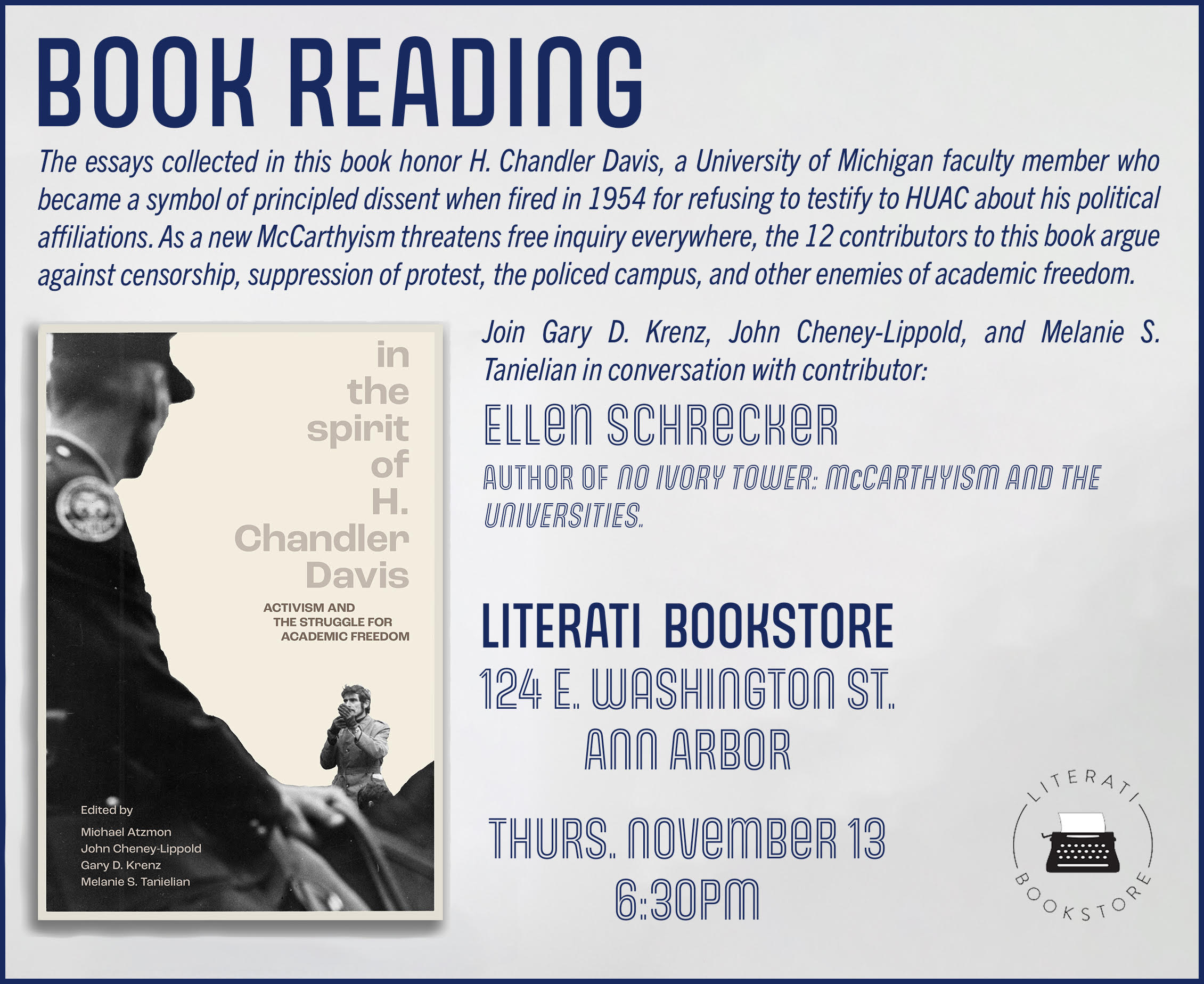
The essays collected in this book honor H. Chandler Davis, a University of Michigan faculty member who became a symbol of principled dissent when fired in 1954 for refusing to testify to HUAC about his political affiliations. As a new McCarthyism threatens free inquiry everywhere, the 12 contributors to this book argue against censorship, suppression of protest, the policed campus, and other enemies of academic freedom.
Join Gary D. Krenz, John Cheney-Lippold, and Melanie S. tanielian in conversation with contributor: ELLEN SCHRECKER, author of No Ivory Tower: McCarthyism and the Universities.
The event will take place at the Literati Bookstore (124 E. Washington Street, Ann Arbor, MI) on Thursday, November 13th at 6:30pm.
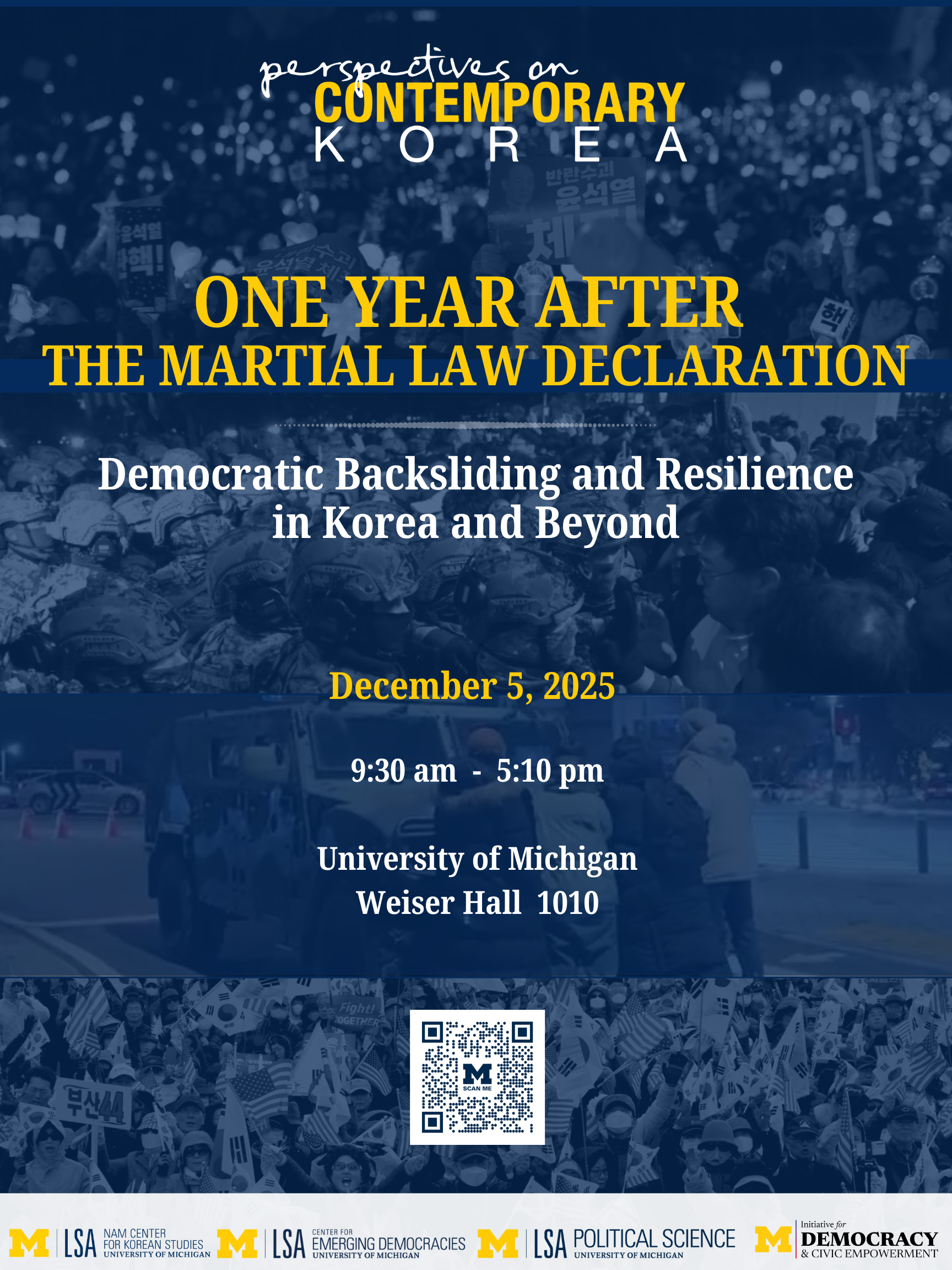
PERSPECTIVES ON CONTEMPORARY KOREA 2025
One Year after the Martial Law Declaration: Democratic Backsliding and Resilience in Korea and Beyond
December 5, 2025 | University of Michigan, Ann Arbor
Weiser Hall 1010
Organizers
Ji Yeon (Jean) Hong (Department of Political Science, University of Michigan)
Juhn Ahn (Department of Asian Languages and Cultures, University of Michigan)
This workshop marks the first anniversary of the unprecedented political upheaval triggered by President Yoon Seok Yeol’s declaration of martial law in South Korea. The event aims to critically reflect on the political and institutional causes and consequences of this crisis, both within Korea and in a broader comparative perspective. In the wake of this extraordinary challenge to democratic norms around the world, what have we learned about the vulnerabilities and the strength of democratic institutions from the experience of South Korea?
By situating Korea within the global wave of democratic backsliding and bringing together scholars working on democratic backsliding from diverse cases and perspectives, this workshop aims to generate new insights into institutional guardrails, civic mobilization, elite behavior, and international influence. It will also examine how Korea’s political trajectory over the past year informs debates about the durability of democracy in both established and emerging democratic regimes.
Co-sponsors:
- Initiative for Democracy and Civic Empowerment
- Political Science
- Center for Emerging Democracies