

In Honor of Chandler Davis, Clement Markert, and Mark Nickerson
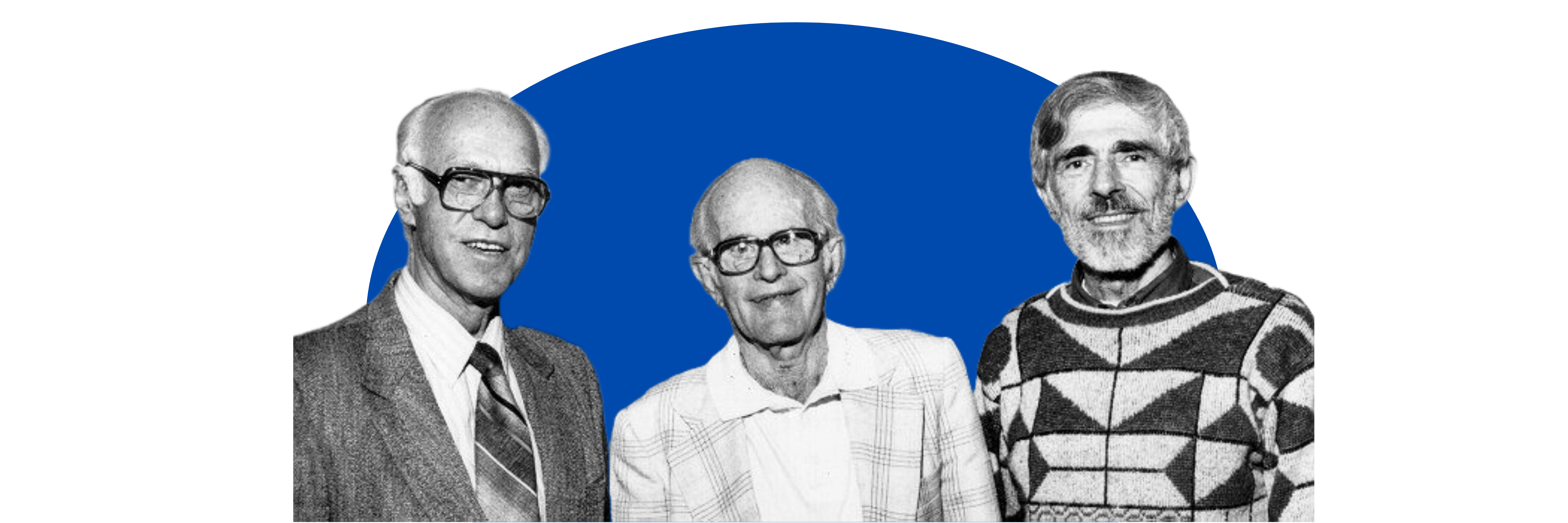
In 1954 the University of Michigan suspended three faculty members for their refusal to give testimony to the U.S. House Committee on UnAmerican Activities. Professors H. Chandler Davis (mathematics) and Mark Nickerson (pharmacology) were fired. The third faculty member, Clement L. Markert (biology), was retained but censured, and left the university soon afterwards. The National AAUP censured the University for these terminations in 1957; censure was removed in 1958 after a new Regents’ Bylaw 5.09 on the “Procedures in cases of Dismissal, Demotion, or Terminal Appointment” was adopted.
In 1988, the film Keeping in Mind was aired by then student Adam Kulakow. The movie featured interviews of the three suspended faculty and documented the impact of these trials on their lives. After the screening of the film, the University of Michigan Chapter of the AAUP contacted various University officials to encourage the Regents to take appropriate action to clear the faculty members’ names. A proposal was sent to the U-M Senate Advisory Committee on University Affairs in October 1989, and endorsed in February 1990.
When it became clear that the Regents would not take action, the U-M Senate Assembly, in November, 1990, passed a resolution that deeply regretted “the failure of the University Community to protect the values of intellectual freedom” in 1954, and established the annual University of Michigan Faculty Senate Davis, Markert, Nickerson Lecture on Academic and Intellectual Freedom:
ADOPTED NOVEMBER 19, 1990
The faculty of the University of Michigan affirms that academic and intellectual freedom are fundamental values for a university in a free society. They form the foundation of the rights of free inquiry, free expression and free dissent that are necessary for the life of the university. The faculty recognizes that such rights are human creations, the product of both the reasoned actions and the deep-seated commitments of women and men. When such actions and commitments are set in human institutions, people may secure for themselves and for others, in the present and the future, the enjoyment of those rights.
We also recognize that these values and the rights they imply are vulnerable to the fads, fashions, social movements and mass fears that threaten to still dissent and to censure carriers of unpopular ideas. Such was the case in 1954 when the University of Michigan suspended three faculty members and subsequently dismissed two of them. We deeply regret the failure of the University community to protect the fundamental values of intellectual freedom at that time. It is to guard against a repetition of those events and to protect the fundamental freedoms of those who come after us that we make this resolution today.
The protection of academic and intellectual freedoms requires a constant reminder of their value and vulnerability. To provide for that reminder, the faculty of the University of Michigan hereby resolves to establish an Annual Senate Lecture on Academic and on Intellectual Freedom, to be named: The University of Michigan Senate’s Davis, Markert, Nickerson Lecture on Academic and Intellectual Freedom.
Relevant Texts:
PRESIDENT HATCHER’S 1954 REPORT
Context:
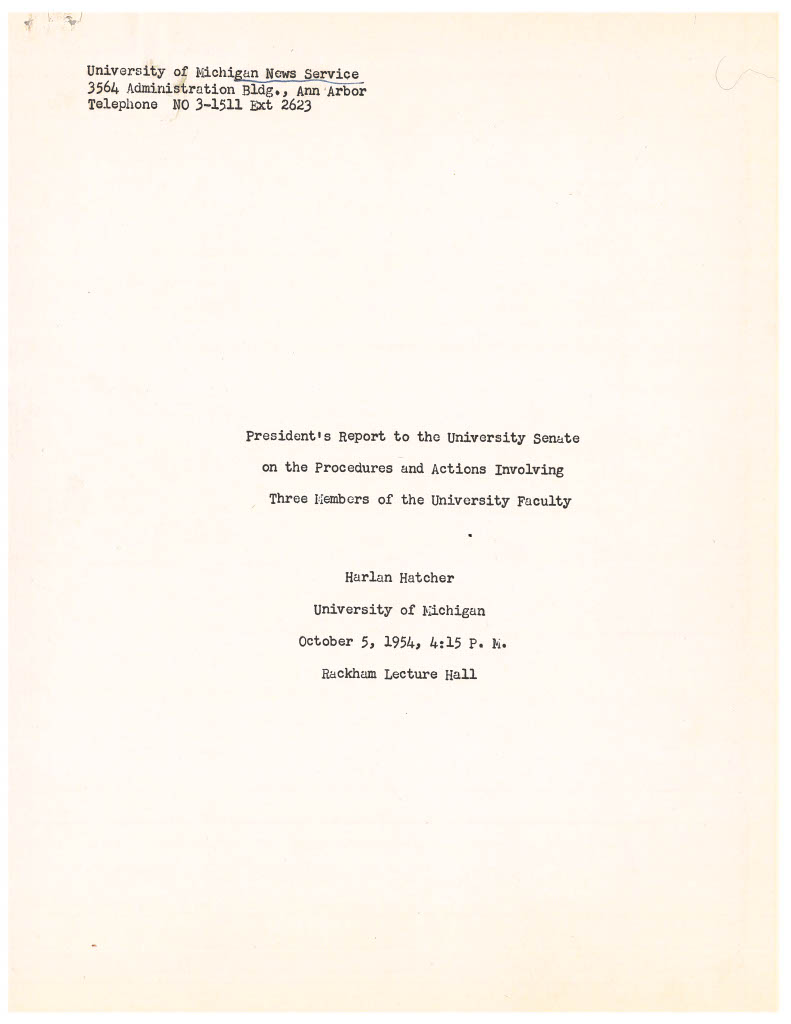
In this report, submitted by then President Hatcher to the University Senate on October 5, 1954, President Hatcher describes the process by which he, the Regents and the U-M Subcommittee on Intellectual Freedom and Integrity came to the decision to fire Davis and Nickerson and retain, but censure, Markert.
Read the President’s full report here.
Excerpt:
“I observe once more that nothing more difficult or distressing can come before a university than conduct of this kind, and that free men, representing a university, having the protection of the institution when their cause is honorable, assume a grave responsibility when they throw upon their colleagues and upon the university the burdens inherent in a refusal to answer questions pertaining to the safety and welfare of this nation on the grounds that a frank answer might incriminate them. There must be good and convincing reasons to justify such a stand.” -President Hatcher, 1954.
OPERATION MIND
Context:
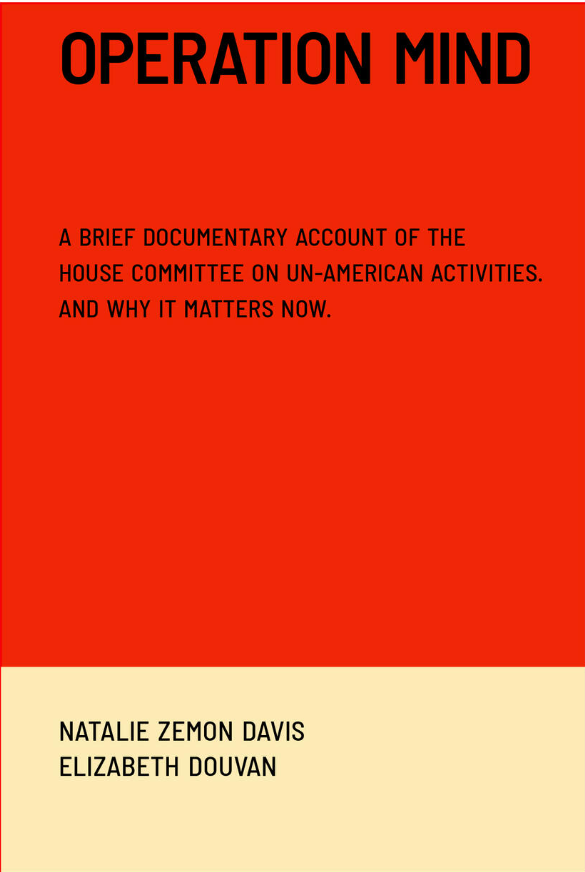
Operation Mind was both written and distributed on campus by a number of concerned faculty and staff. Natalie Zemon Davis, Chandler Davis’s wife, and Elizabeth Douvan were the authors of this work. Chander Davis and a group of students typed the book, and Chandler Davis’ name was on the receipt for its printing. This printing receipt led to his investigation and his being targeted by the U.S. House Committee on Un-American Activities.
About the Work:
Natalie Zemon Davis and Elizabeth Douvan’s Operation Mind is a body of evidence, a prophetic warning, and a call to action about the urgency of doing all we can to prevent thought control in America. In 1952, their meticulously researched pamphlet documented the House Committee on Un-American Activities’ attacks and impact. The HUAC abused its charge to intimidate and silence academics, union members, social critics, scientists, artists, teachers, political opponents, rabbis and other religious leaders, in order to make them appear suspect and “un-American” in the eyes of the American people.
The 2025 reprint of Operation Mind offers a foreword by Silke-Maria Weineck, a 2023 introduction to the text by Natalie Zemon Davis, and a 2025 essay by historian Alan Wald connecting Operation Mind’s history of McCarthyism with present-day attacks on academic freedom.
Buy Operation Mind via this link.

STATEMENT ON ACADEMIC FREEDOM
Context:
On January 25, 2010, the Senate Assembly adopted a statement on academic freedom.
Excerpt:
“On behalf of the University of Michigan Faculty Senate, the Senate Assembly defines the following standards of academic freedom:
Academic freedom is the liberty that faculty members must have if they are to practice their scholarly profession in accordance with the norms of that profession. Academic freedom is not a term or a condition of employment; rather, it is based in the institutional structure of this and other universities and is fundamental to their common mission of promoting inquiry and advancing the sum of human knowledge and understanding. Although some aspects of academic freedom are also protected by the First Amendment to the United States Constitution, academic freedom exists, independent of any external protection, as a basic prerequisite for universities to fulfill their mission to our society. Academic freedom is most commonly vindicated by individual faculty members, but remains first and foremost a professional prerequisite of faculty members as a group.”
Read the full Senate Assembly statement on academic freedom here.
Other Texts Related to Academic Freedom

Unfettered Expression by Peggy Hollingsworth, published 2000.
A group of major thinkers addresses fundamental questions of intellectual freedom both within and without the academy. The essays in this volume were originally given as lectures in a series established in 1991 to honor three University of Michigan faculty members who, in 1954, refused to testify before the House Un-American Activities Committee and were thereafter suspended or dismissed by the University.
The authors reflect on the questions and challenges to academic freedom that the predicament of those three scholars put into such sharp focus. This readable, yet profound, work brings together the thoughts of Robert M. O’Neil and Lee C. Bollinger on “The Open-Minded Soldier and the University,” Catherine Stimpson on “Dirty Minds, Dirty Bodies, and Clean Speech,” Walter Metzger on “A Stroll along the New Frontiers of Academic Freedom,” Linda Ray Pratt on “Academic Freedom and the Merits of Uncertainty,” Roger Wilkins on “Opportunity and Academic Integrity,” Eugene L. Roberts, Jr. on “Free Speech, Free Press, Free Society,” and David A. Hollinger on “Money and Academic Freedom a Half-Century after McCarthyism.” Avern Cohn brings a different perspective to bear with his thoughts on academic freedom from a trial judge’s point of view.
This is a book of interest to all concerned with the fundamental issues of intellectual freedom and the right to hold nonconforming views. Peggie J. Hollingsworth is Assistant Research Scientist, Environmental-Industrial Health Department, School of Public Health, University of Michigan. [Book description from the University of Michigan Press website.]
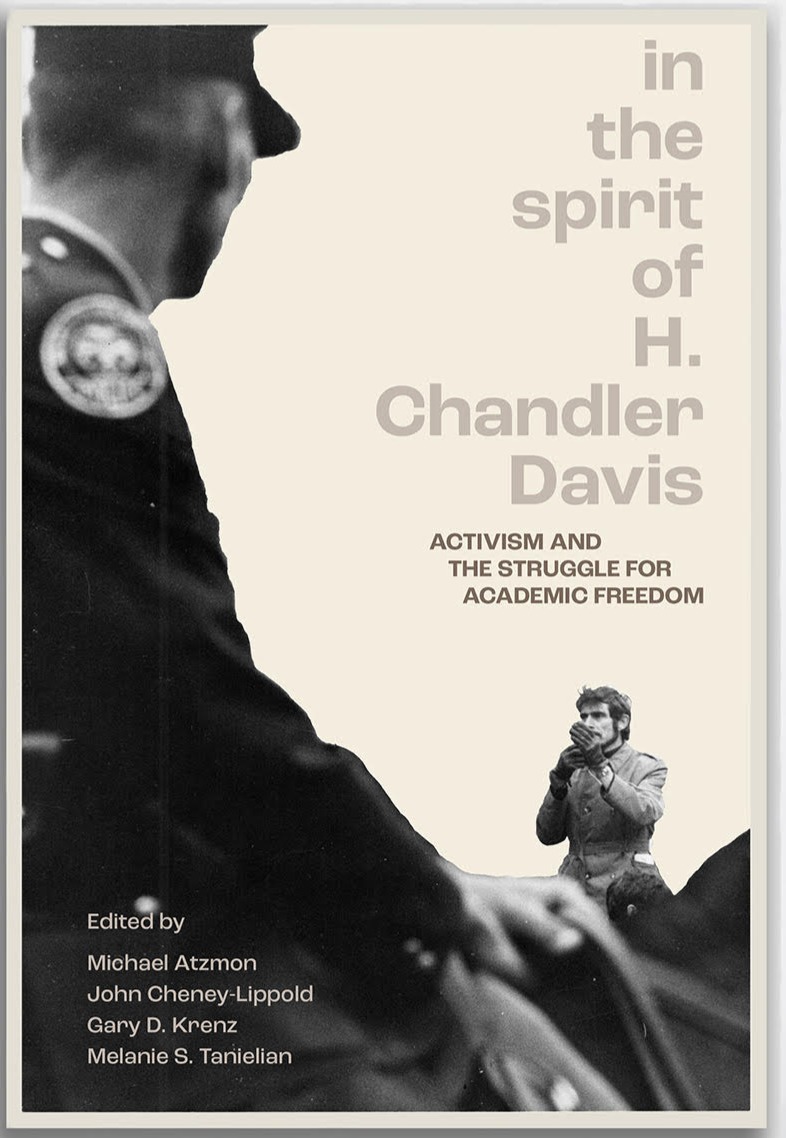
In the Spirit of H. Chandler Davis: Activism and the Struggle for Academic Freedom.
Edited by Michael Atzmon, John Cheney-Lippold, Gary D. Krentz, and Melanie S. Tanielian.
The essays collected in this book honor H. Chandler Davis (1926-2022), a University of Michigan faculty member who became a symbol of principled dissent when suspended and fired in 1954 for refusing to testify about his political affiliations to the House of Un-American Activities Committee. Invoking academic freedom and the First Amendment protection, Davis was convicted of contempt of Congress. He served six months in prison before moving to Canada, where he established himself as a brilliant mathematician, prolific writer, and ardent and much beloved advocate for justice.
At a time when a new McCarthyism has come roaring back to threaten free inquiry everywhere, the 12 contributors to this book argue against the self-silencing of “institutional neutrality,” and other enemies of academic freedom. Also included in this volume is posthumously published work by Davis and his late wife, the historian Natalie Zemon Davis, which reflects on the importance of facing, and not accepting authoritarian regimes.
Inspired by Chander Davis’s courage, integrity, and devotion to the struggle against oppression, injustice, and the persecution of speech, these essays offer crucial insights into the importance of defending intellectual independence, institutional autonomy, and the right to free expression.
Biographies:

CHANDLER DAVIS
1926-2022
In his youth, Chandler Davis was well known as a science fiction author, as he also pursued mathematics at Harvard, earning a Ph.D. in 1950. He was an instructor at the University of Michigan, 1950-1954, and, in 1962, joined the University of Toronto as a professor of mathematics. He was Vice-President of the American Mathematical Society (1991-1994) and served as an editor of The Mathematical Intelligencer. Professor Davis traveled extensively as part of scientific pursuits, including to Poland during the martial law of 1982, to the Democratic Republic of Vietnam while the U.S. and Vietnam were at war, to China during the Cultural Revolution, and to Israel and occupied West Bank. Along with his scientific work, he advocated for free speech for scientists, including speech he did not always agree with.
In 1954, while an instructor at the University of Michigan, Chandler Davis was called to testify before the House Committee on Un-American Activities. Also called to testify at the hearing, held in Lansing, MI, were his colleagues Mark Nickerson and Clement L. Markert, and friends Edward Shaffer and Myron E. Sharpe. All were considered to be “unfriendly witnesses, refusing to confess” because of their political dissent. Davis, unlike the others, based his refusal to answer solely on the First Amendment and chose to waive his protections under the Fifth Amendment. By doing so, he deliberately invited a citation for Contempt of Congress, thereby giving him cause to argue in court that the Committee’s proceedings were unconstitutional. While he received the citation for contempt, he did not prevail in court; his appeals were exhausted in 1959 and he served prison time in 1960. Meanwhile, he and Professor Nickerson were dismissed from their positions at the University of Michigan. This dismissal by the University administration drew censure by the American Association of University Professors. He wrote about these events in “The Purge” (A Century of Mathematics in America, American Mathematical Society, 1989). A selection of his prose writings, including some science-fiction, was published in It Walks in Beauty (ed. J.Lukin, Aqueduct Press, 2010).
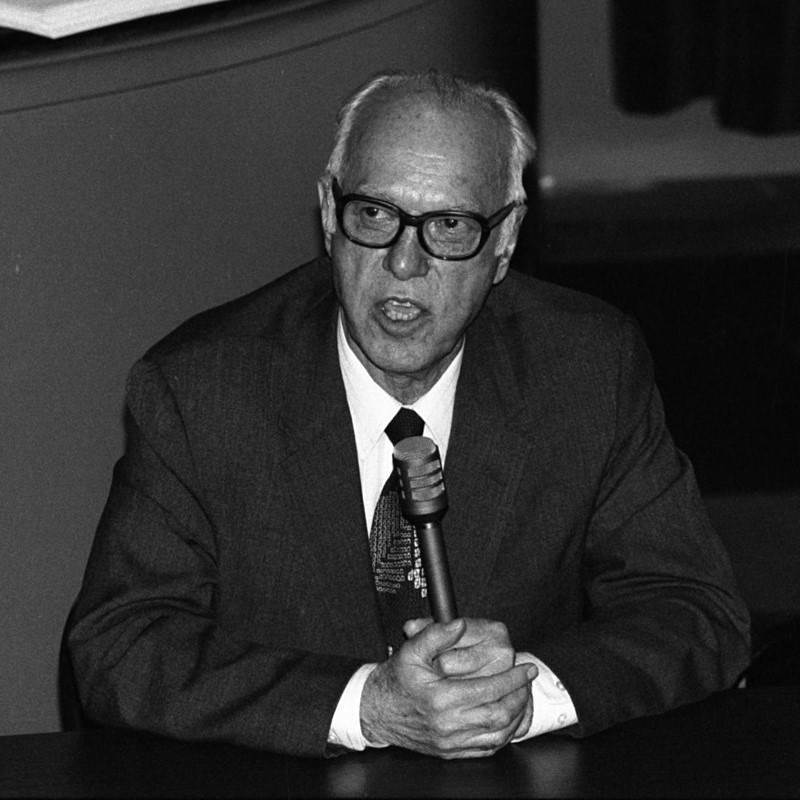
CLEMENT L. MARKERT
1917-1999
Clement L. Markert earned a bachelor’s degree from the University of Colorado, a Masters degree from the University of California at Los Angeles, and a doctorate from Johns Hopkins University. He began his academic career as an assistant professor of zoology at the University of Michigan in 1950.
In 1954, Clement Markert was called to testify before the House Committee on Un-American Activities. He invoked the Fifth Amendment and refused to answer the Committee’s questions concerning his political associations. Based upon these events, he was suspended from the University of Michigan. He was later reinstated with the support of the Faculty Senate, his department, and college, and eventually was granted tenure. Clement Markert left the University of Michigan to become Professor of Biology at Johns Hopkins University (1957-1965), the Henry Ford II Professor of Biology and Chair of the Department of Biology at Yale University (1965-1986), and Distinguished University Research Professor of Animal Science and Genetics at North Carolina State University (1986-1993). His research interests were focused on developmental genetics, reproductive biology, and biotechnology. He was a member of the National Academy of Sciences and served as co-chair of the Developmental Biology Interdisciplinary Cluster for President Ford’s Biomedical Research Panel in 1975. Professor Markert also affiliated with the Presidency of the American Institute of Biological Sciences, the American Society of Zoologists, the Society for Developmental Biology, and the American Genetics Association. He died on October 1, 1999, in Colorado Springs, Colorado.
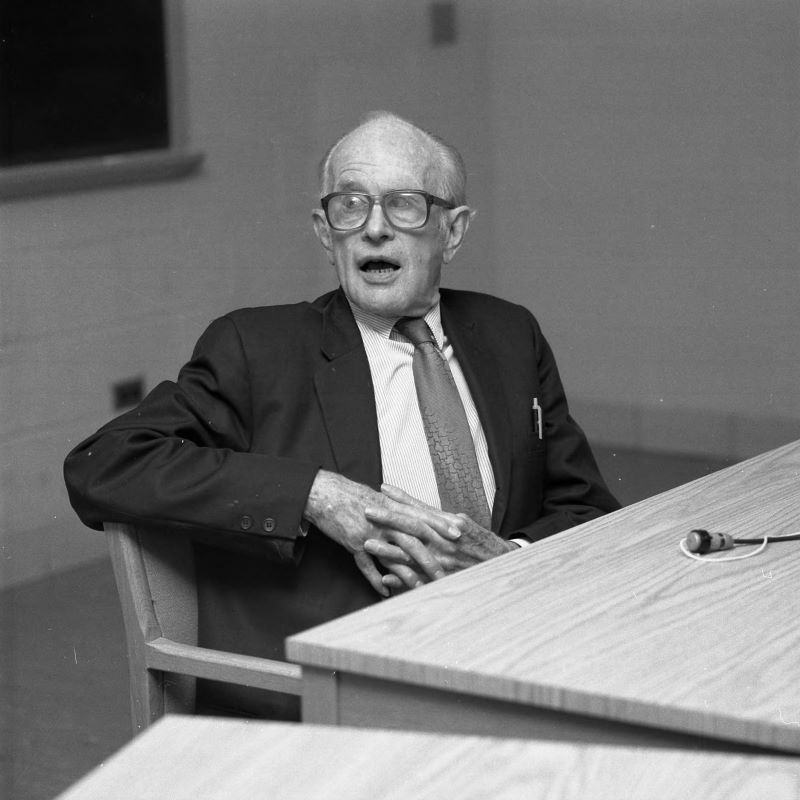
MARK NICKERSON
1916-1998
Mark Nickerson was born on October 22, 1916, in Montevideo, Minnesota. He graduated summa cum laude from Linfield College, earned a Sc.M. from Brown University, a Ph.D. from Johns Hopkins University, and an M.D. from the University of Utah. Professor Nickerson made major contributions to the field of pharmacology, in part through his seminal research on the adrenergic blocking drugs used to treat high blood pressure. He was awarded the John Jacob Abel Award in Pharmacology in 1949 and served as president both of the Pharmacological Society of Canada and of the American Society for Pharmacology and Experimental Therapeutics. He chaired the Canadian Federation of Biological Sciences and was the author of more than 250 scientific publications.
In 1954, Mark Nickerson was an associate professor of pharmacology at the University of Michigan, with tenure. He was called to testify before the House Un-American Activities Committee and chose to invoke the Fifth Amendment in response to the Committee’s questions. As a results of these actions, he was immediately suspended by the University. Professor Nickerson’s reinstatement was supported by the Faculty Senate but not by his department chair, dean or by the executive committee of the Medical School. He was subsequently dismissed from the University despite his tenured appointment.